Clay Pots
Rather than something I use to organise my life, writing fills the spontaneous gaps away from anyone who might need me. The focus required to meticulously scrutinise every line is so intense that I sort of disappear from my own life when I do it. So, it perhaps makes sense that I produce my best work in busy places, where there are no silences to fill and no social obligations. I’ve learned I don’t need solitude, but anonymity in order to write. For this reason, my creativity will always be a negotiation.
You could describe my struggle to do this thing I love as something negative. I’ll never be zen, or at peace. Nothing will ever be in perfect balance for me. But I try to cultivate my creativity in unlikely places, with the hope of leaving this world better than I found it. I wake knowing there is always something to do.
These thoughts find me in a brightly-lit corner of the motorway services. My own reflection is sitting in the window next to me, like a double exposure; a ghost with a furrowed brow amongst the dew-soaked grass, sprouting daffodils and the bright red bins on this cold morning. Service stations like these are uncanny, unhomely places. I like the obvious anachronisms; old doors and vents masked by glaring restaurant logos, or the stained carpets around the fruit machines. Perhaps that’s why I can write here: I’m away from the rhythms of home that continue to shape me. There’s no surging current, no inertia or expectation. This is a place where things come to a temporary stop.
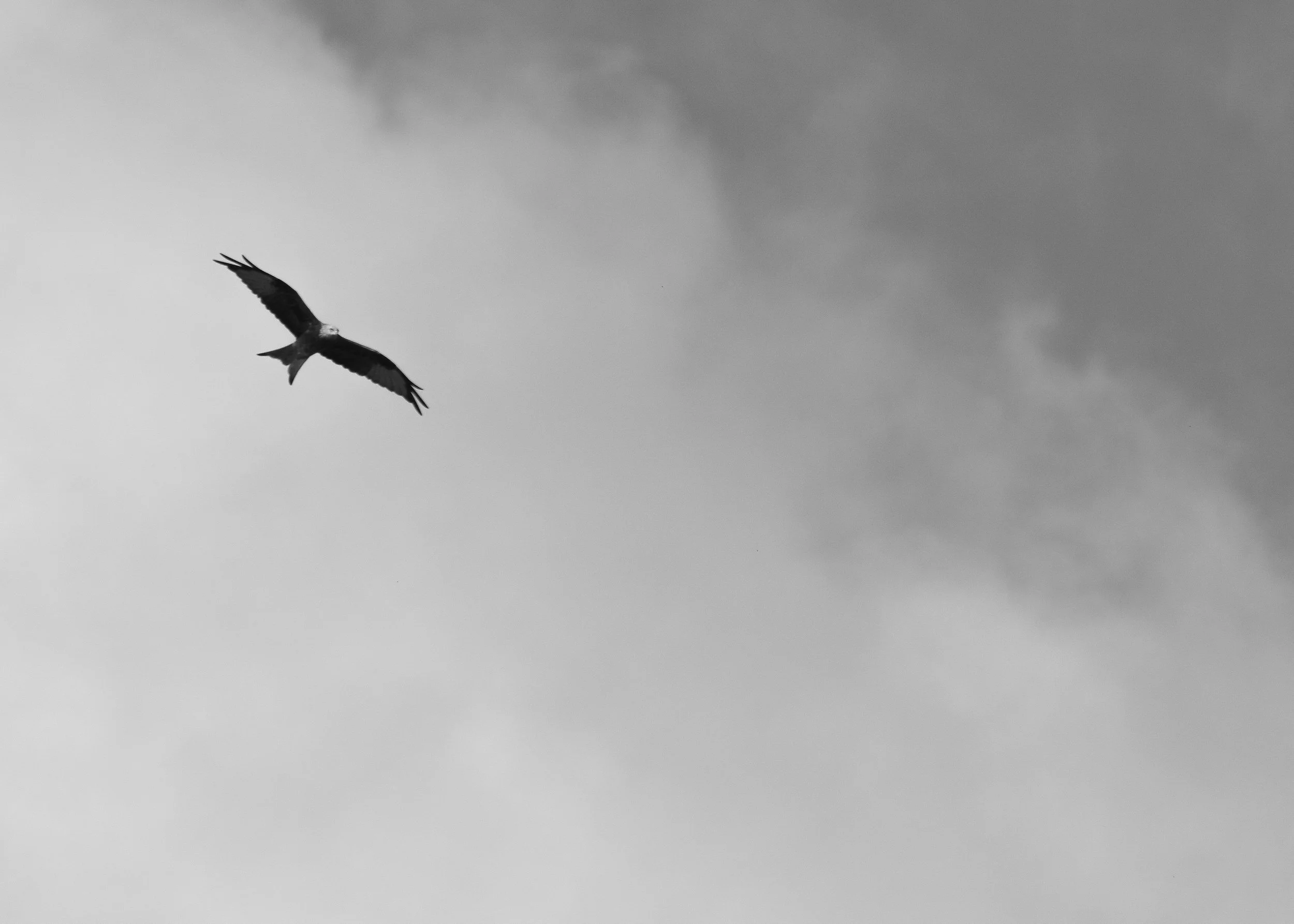
But life hasn’t stopped here, not in the least. Compressed by concrete and billboards, earthly rituals are as dependable as ever. Even here, where people assume it has no right to be, spring is forcing its way into our lives, regardless of whether or not we stop to notice. Above the steady thunder of the motorway, I hear a blackbird singing. The hawthorn boundary of this strange waypoint is greening with leaf buds. I watch a squirrel exit a bin with ketchup on its tail while rooks crisscross the picnic tables carrying nesting materials. The window is cool to the touch.
Spring isn’t just what’s in the soil, but the scent in the air, and the sounds it carries as it rushes in through hedgerows and articulated trucks. I like to notice these seasonal changes, like the call of a chiffchaff, or the hue of goat willow reflected in a puddle. These moments so effectively collapse my perception of time that the forgotten truths of my younger self rise to the surface, imbuing my awareness of spring’s arrival with a depth of meaning I can’t articulate. It feels like a sense of belonging rather than inner peace, which I think comes from a history shared with a place and a people half a mile from the next junction. I sense this coursing through me whenever I slow down and put pencil to paper. But after a very wet, dark winter, the unconscious competence I employ when writing about landscape has hardened and withered from lack of use. The act of noticing seems more difficult than I remember.
Unlike today’s mass media, twenty-four seven, next day delivery culture, older communities were more attuned to seasonal processes. I’m not suggesting these were idyllic, halcyon days without narcissism or class antagonisms, but a sense of community existed without the need for endless bureaucratic categorisation. There was, perhaps, a sense of work needing to be done that actually could be done by the people thinking that. The answer to the problem wasn’t blackboxed behind layers of media speculation and political mismanagement. In many cases the ability to get out and do the work of harvest or home repairs would have been now or never. Daily life was at stake. Today, we mostly swim in overabundance. There’s been a move towards communication without community. Regardless of the season, less and less is done on trust, perhaps because it takes so long to cultivate. There isn’t a BUY NOW option for friendship, self-belief or purpose, however hard the internet might try to convince us of the opposite. At heart, humans are narrative creatures. We create meaning, experience conflicting emotions, and mark time in different ways.
I come here, to the services, to gain some perspective on these dynamics. It feels like stepping out of the current as the flow of information barrels past me. This helps me open my notebook and start writing. Despite feeling frustrated at the time constraints of work and the spiralling cost of living, I see a blank page as an opportunity still to come, not a failed attempt to be creative. I like thinking about people who make clay pots: for thousands of years they’ve created something useful around an absence. They make containers with nothing in them. So absence or lack is necessary to get something going. Only then can the work find its place in a wider context.
And so spring, arriving from the cracks in the concrete or on the wind, reminds us that seamless, perpetual consumption isn’t natural. Endless abundance isn’t good for us. We need variety, compromise, and at least a few ways to escape society’s gaze. Without winter’s lack of warmth and sunlight, spring buds wouldn’t open in March. And as a chaffinch calls, I remember the spring I learnt its song. Noticing, however we chose to do it, seems suddenly more important than ever. As trivial as a chaffinch may be to the people around me, it’s enough of a hook on which to hang the last twelve years of my life: who I was before I could name one, and how my life feels now. Noticing helps us shape meaning from the unlikely and mundane, and I am always glad to do so. Without it, adrift in the metaverse or some such horror, I would most certainly be lost.