Into the Pain Cave
It’s perhaps surprising that a BMX podcast was the thing to kick me out of a two month despair spiral. Since completing Shared Territory and leaving full time work, the interconnectedness of… everything has been paralysing. What I usually see in myself as a positive attribute (an ability to make connections), has felt like an intricate web of my own devising, from which I can’t break free. I’ve tried analysing my way out, talking about it, writing about it… but I just feel like I’ve wasted my breath, my ink, and precious, precious time. I’ve tried ignoring it all, and just listening to podcasts about Cormac McCarthy at 3am. I’ve tried DIY, gardening and long walks, but this creeping sense of shame has broken me. Why am I wasting a golden opportunity? I have comfort and I have time, but somehow I can’t summon what’s required to write for work.
I’m distracted with worry during even the most menial tasks now, like walking the dog or washing up. My thoughts run and run and I feel like ideas and influences or solutions are racing past as I try to solve my dilemma: how to financially contribute to our household while retaining the flexibility I need day by day to address family matters, stay healthy and continue writing.
Life was simpler before I had literary ambitions. Pre-university, aged 24, my life was about bikes. What job I had didn’t really matter so long as it paid for new bike parts and fuel for my van. I was young enough not to worry about diet or hangovers or mortgages. I just worked and rode bikes in every bit of spare time I had. As I’ve depicted in Shared Territory:
I never really believed I’d get sponsored and make a career out of it, but there was a certain amount of pride and esteem associated with being able to deploy bike skills in new places, similar to identifying trees or birds somewhere new, or arriving on holiday able to chat with the locals in their own language. But for me, bikes have always led to more; more friends, more places to visit, more things to look back on and smile. To live and breathe bikes is a lens through which to view the world, one where each ledge or bank by the roadside has the potential to be ridden.
Before I ever went to university, I learned filming techniques and editing software to make my own bike videos, which were like medals for noncompetitive sport. I loved seeing my progression. It seemed the only thing free from the world’s expectations. My friends and I would spend the winter months practising in multistorey car parks just so that, come spring, our group could turn up at some new trails and represent. We each had our own style, our own tricks we’d chosen to focus on. We’d all find our way into a session, putting new skills to the test in new places, or dialling in a trick we’d failed to unlock last summer. If we were good, people would want to know our local spot. They’d want to make their own visit to where we learned these skills, to see what it might offer them. The clichéd line from a dozen bike films is “we feed off each other,” but in reality, it is true. The vibe of a good session at the skatepark or a set of trails will ramp up as more good things happen, leading people to push their limits further. There’s a sense of being in the zone, of rising to the occasion, collectively.
These paragraphs are from Chapter 5, where I’m joined by Grant ‘Chopper’ Fielder, one of the UK’s best dirt jumpers throughout the 00s. He grew up on the banks of Bartley Water too, and shares my feelings about how being enmeshed in the world of riding bikes was like an aperture through which the rest of the world made more sense.
What I learnt from writing the book is that I don’t have a very strong sense of self. In life, I perform more of a function, which is that of a conduit: I connect people and place, or big ideas with everyday language. I feel compelled to understand logistics and processes so that I can anticipate what might happen, and temper potential anxiety with appropriate contextual language for whoever I’m addressing.
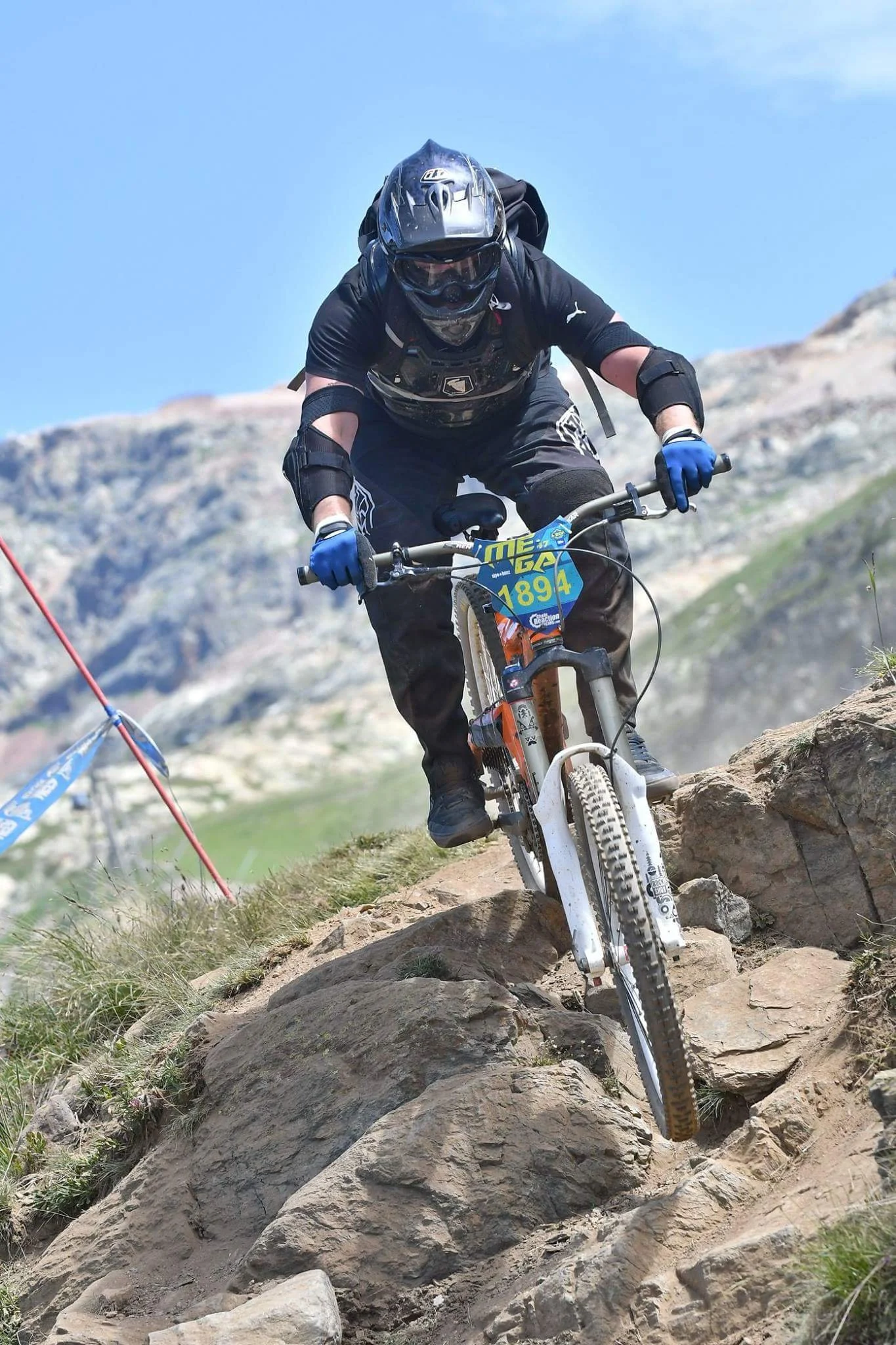
I did the same with bikes, walking a track before riding it, conducting micro-risk assessments around every corner, scrutinising video footage for clues on how to perform a certain trick. But the goal of this silent work was very simple: ride the trail as smoothly as possible. There was a sort of style in having this as my aim, as opposed to boosting off every jump or kicking up more roost in the corners than anybody else. This style I was hoping to emulate from bike magazines like DIRT or videos like SPRUNG 4 and the EARTHED series was a signifier in the world of mountainbiking. It said something about me without me having to explain it. The context became obvious from the action, and gave me a place in the community of mountainbikers in our area.
In those halcyon days of cut shins and sweat-stained t-shirts, collectivity came easily. Mountainbiking is not a team sport. (I’d even argue the kind of riding we did was more a mode of creative expression than a sport at all.) But to be a rider meant you belonged in relation to your bike, the trail and other riders you met along the way. Membership requirements were simple:
Say hi when you turn up and say bye when you leave, even if you’re in a bad mood
Don’t cut in on people waiting their turn
Repair any trail damage you cause
Don’t spend all day sat astride the most expensive bike there and never actually ride it
Perhaps craving this sort of simplicity was on my mind when, instead of listening to more discussions about American literature, I returned to the UNCLICKED podcast I’d discovered during the lockdowns. The episode featured Jamie Bestwick, a British BMX rider who won 13 X-Games gold medals for vert. He is very precise with his words, and every sentence felt like guidance. When asked about challenges in his career, he cited Dave Mirra as his toughest competitor. Mirra was an icon of the sport who’d been dominating BMX for years, and was effectively the gatekeeper to success across the late 90s and 2000s.
The discussion turns to the first time Bestwick beat Mirra in a contest. The elation didn’t last long: ‘It was mindblowing how he’d come back stronger in such a short space of time. After losing the contest, in the off-season he went into hiding. Which meant he built a resi and a bigger vert ramp [in his yard] and went to work.’
When Mirra returned to competition, nobody else stood a chance.
‘He went away and worked harder than I did,’ says Bestwick. ‘He went in the pain cave and what he came out with… I was like… where’s he got these tricks from?! All brand new. Nobody’d ever seen anything like it before.’
On a parochial level I did the same. I’d go out riding on my own at night, spraining wrists, rolling ankles, grazing my chin in an attempt to learn a new trick. I put in the work so I could turn up at the weekend with something new. It’s a sort of metamorphosis. You hide away and work until you’re ready to show what you can do. I guess there’s an element of showmanship to that, and that’s exciting. There’s an appeal there, even if it seems arrogant to say so. You don’t visit the circus to watch people learning to juggle fire.
Hearing someone say ‘going into the pain cave’ is ringing in my ears this week. The language of bikes is so unconvoluted. It’s refreshing, and for me, a bit nostalgic.
Social media and our attachment to constant updates via Whatsapp etc., has made it very difficult to hone a craft in private. It’s like identities are about the struggle rather than what’s produced. This constant need to demonstrate our processes, our battles and hacks has demystified nearly every creative and sporting practice. The visceral, emotional impact of true craft and showmanship seems less important than perpetually capturing attention. And that doesn’t sit well with me. Respected personalities were enigmas, now they’re brands.
When social media began, or certainly when Twitter took off, unpacking the myths of creatives and sportspeople was a novelty. With working-class roots, I was certainly excited to connect with literary figures I couldn’t have imagined engaging with previously. Maybe we all learnt something valuable from peering into the daily lives of people we respect and admire. But it really feels like, especially this year, we are truly oversaturated. My fascination with Bestwick’s interview is due to the magic era he’s describing: pre smart phones, big personalities, limited media coverage. There are still a few secrets there. Access to the worlds of our heroes was so sparing that people like Dave Mirra could transcend daily life. That held my attention, and it inspired me to find my own novel routes to success, however strange I might have looked falling off my bike, alone, on the carpark’s CCTV.
I think then, I want to bring the logic of those times to my life today. How did I solve problems in 2006? I took what I needed to know from specific sources, then isolated myself and put in the work. My motivation was to belong in a part of the world I really loved. Although writing creatively is a lot more multi-faceted and uncertain than mountainbiking, I do at least anticipate less trips to A&E this time around.
Strangely, hurting myself never bothered me. I think it affirmed my boundaries - and therefore, my sense of self - in a way you can’t argue with: this is where my elbow ends and the pavement begins. I was still a conduit, bringing the style of my heroes from magazine pages to my own movement around the skatepark, but my sense of self was being constantly reinforced in a way I haven’t felt since. The limits were clearly there and could be pushed.
So, sitting here at my laptop, something about that old way of approaching a challenge takes on a new appeal. I’m not saying I want to be the Dave Mirra of narrative non-fiction and hard sci-fi lit., but maybe some time back in the pain cave would do me good. Who knows, I might come out with something unexpected.